

A Reading from the Holy Gospel According to Matthew
Jesus said to his disciples: “If your brother sins against you, go and tell him his fault, between you and him alone. If he listens to you, you have gained your brother. But if he does not listen, take one or two others along with you, that every word may be confirmed by the evidence of two or three witnesses. If he refuses to listen to them, tell it to the church; and if he refuses to listen even to the church, let him be to you as a Gentile and a tax collector. Truly, I say to you, whatever you bind on earth shall be bound in heaven, and whatever you loose on earth shall be loosed in heaven. Again I say to you, if two of you agree on earth about anything they ask, it will be done for them by my Father in heaven. For where two or three are gathered in my name, there am I in the midst of them.”
(Matthew 16:21-27)
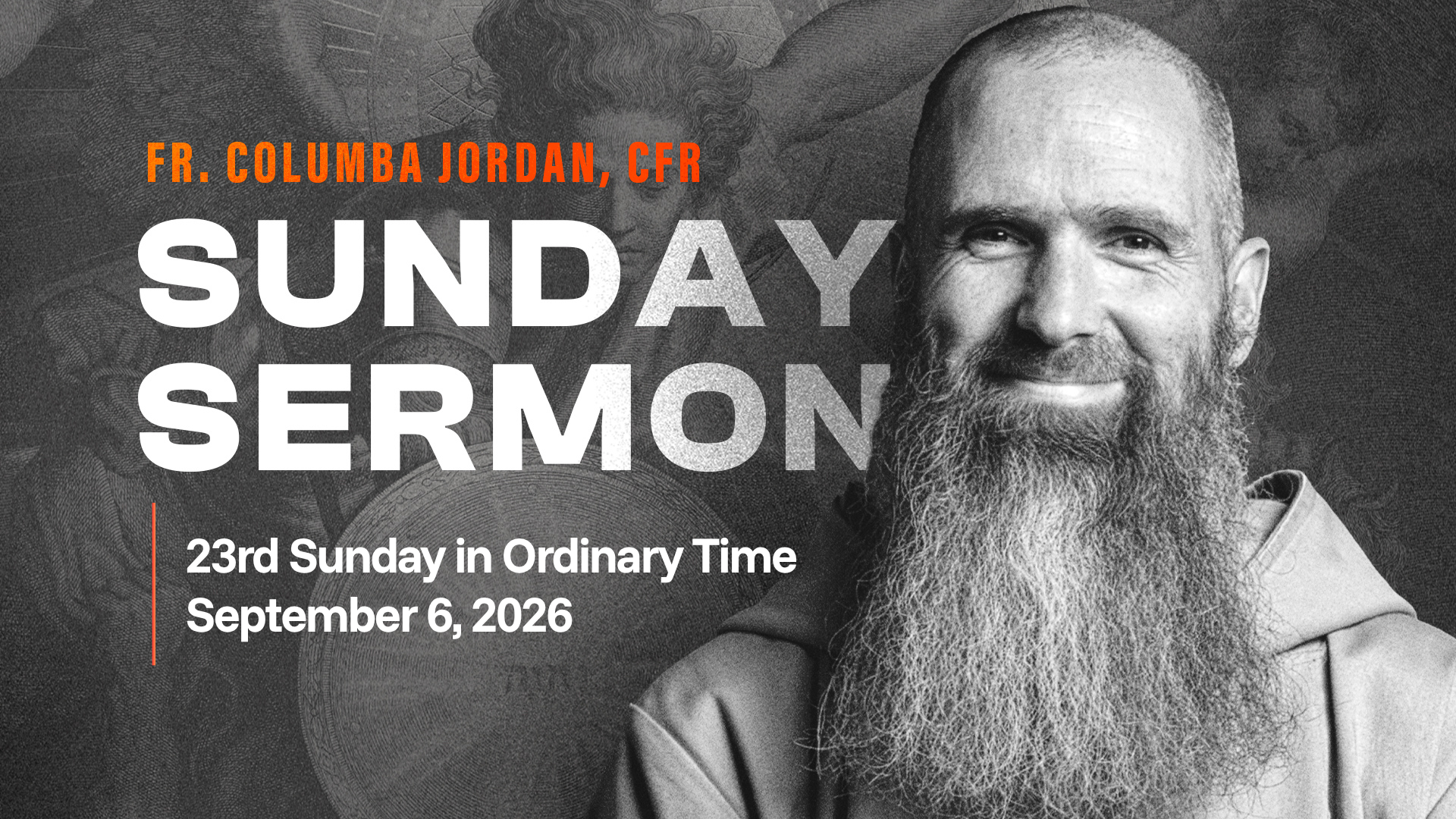
Fr. Columba’s Sunday Homily for Exodus Men
Jesus gets very practical in today’s Gospel. The Gospel is full of the message of forgiveness. Jesus himself modeled this. But he also modeled healthy confrontation in relationships. When Israel and its teachers were off, he held them to account. When he gave the four or seven woes to the Pharisees and scribes, he wasn’t offering the other cheek at that point. This is what love looks like. Sometimes it says, “No, this is wrong. You are misleading the people, and I’m going to rebuke you.”
Jesus modeled this with his own disciples. As we saw in our previous weeks, he called Peter “Satan.” He rebukes him immediately when Peter says something that sounds all holy, but is wrong. It’s so important that we are able to do this and not think that Christianity is some mewling, nicer-than-nice “Oh no, I can’t say anything to anybody. I have to be a doormat.” That is so inaccurate. We look to Jesus, and if we don’t understand the message, we look to how he lived.
When someone sins against us, we go and we talk to him. We go and tell him his fault—this is what Jesus says. We actually have to go and say, “Listen, you did this. Talk to me. What did that mean?” I’ve taught on this a lot—the importance of healthy, holy, loving confrontation.
If someone does something to us, we always want to hold off on rash judgment. Rash judgment is where we presume we know the motives of another for some bad that we think they’ve done. We hold off on that because it’s very tempting. Instead, we say, “No, there may be some way that they don’t understand what they’ve done, or they misunderstand. There’s some explanation where they’re actually doing it virtuously.” So we always hold on to that, and we wait. We want to calm our hearts so we don’t act out of anger. We’re not looking for revenge. We actually want reconnection. We’re in this for them. We go to them out of love. It might take a little bit of time to calm down. We might need to ride out the anger for a little bit just to process it, get a little handle on that, and then go talk to them.
St. Paul says, “Don’t let the sun go down on your anger.” Why? Because, as he says, we don’t want to give the devil his opportunity. When we sit on anger, and we don’t resolve it and talk to the person, have it out in a loving way, it sits, and it festers. And we put it on action replay, and we get more and more bitter, and we more and more demonize the other person. So it’s important that, before the sun sets, if you can’t talk, at least you make an appointment to talk with that person as soon as possible. When I do this, I always say, “Okay, here’s what I saw you do or heard you say.” No judgment on motive. No attempt to embellish. Don’t say, “Clearly you did this. You were so offensive to me. You did that thing.” Simply say, “This is what I saw. This is what you said. This is how it made me feel.”
We may not be entirely comfortable sharing that, but I highly recommend it. Why? Because it’s vulnerable—and we want to lead with vulnerability. We don’t want to lead with a knife, an accusation. We simply want to say, “Hey, you said such and such. It was in this context. To be honest, I found that really, really difficult. I found it kind of insulting, but I’m sure you didn’t mean that. Can you help me understand what you meant?” Sometimes they will say, “Do you know what? I was really angry with you. I said that out of anger.” And they might apologize. Very often—most often, I have found—people didn’t mean it. So it gives them an opportunity to say they’re sorry.
It’s important that we bring this to people, but that we don’t back-reference. This is not an opportunity to recall the last six months of grievances. We’re not going to say, “You always do this.” Avoid all of that. Vagaries are not helpful. It has to be really, really specific: this thing that we both know and remember clearly because it was today, maybe yesterday. If the other person starts back-referencing and says, “Well, you always do this,” then just say, “Okay, I’m very willing to talk about that, but is it okay if we just resolve this one first of all? And then, if you’ve got something, we can talk about that. And if I have hurt you in some way, I’m very sorry.”
Sometimes people are not willing to engage. Then, as Jesus says, sometimes we need to bring someone else in. There can be too much hurt, too much anger. Both can be whipped up with rage, maybe from years of resentment. I have been in these situations sometimes. It takes a third person who is not leaning one way or the other, someone who is on both sides or entirely neutral and who can translate. This is why some couples go to couples therapy. We need a third party who can step outside of the drama and say, “Okay, here’s what I hear.” They can be that other voice to help us. And very often, that can help bring peace.
If it doesn’t bring peace to personal relationships, it doesn’t necessarily mean we’re going to take it to the Church. That would be more in terms of, say, theological issues. This happens. If a theologian says something and it’s incorrect, there’s a process where, very charitably, the Church will approach them and say, “We have a question about what you said in your book. Can you explain that?” And then they’ll say, “Can you clarify that you mean it in this way and not in that way, so that the faithful aren’t confused?” If they refuse and refuse, the Church has at times told theologians they can’t teach, or they’ll outright condemn the work. This does happen, even in our day. This has happened where people are unrepentant.
For ourselves, we hope it won’t come to this, especially in our intimate family relationships. Sometimes somebody is just so entrenched. For example, where there has been some form of abuse, or somebody has an addiction, and it’s emotionally devastating to the family. That could be an occasion where the initial conversation is not happening. If you bring someone else in and nothing happens, then maybe you bring in the wider family. There’s a bit of an intervention, and I have seen situations like this. I’ve even seen it in the religious life—to help somebody to wake up. And if they’re not, then comes the nuclear option, which we try to avoid, but at times it can be necessary—we say, “We cannot have a connection until this is shifted.” The wife with the alcoholic husband is the classic example of this, and she can say, “Listen, you are free to drink, but if you do, the kids and I are going to my mother’s until you show proof of transformation.” That is a real option. It’s not against Church teaching or anything, so long as the goal is, “I am doing this out of love. I am doing this because I’m for this relationship, and I need to protect this relationship, because if I stay in harm’s way, all that’s happening right now is harm.” As I said, sometimes when there’s addiction involved or severe mental illness, the only thing we understand, unfortunately, is pain. And these confrontations can help us realize and see reality. What is it that we really, really value?
And to realize, brothers, that this is something Christ teaches us. This isn’t some pop psychology. It’s not just some seven-step self-help book you picked up at the airport. This is from Scripture itself. These are from the words of Truth himself. How do you feel? Depending on where you’re from, you may be more or less comfortable with confrontation. Regardless, it’s something we’re called to do. Relationships and love demand it, because otherwise we’re just storing up resentment, and we’re not really living in love.
St. Paul says we have to live the truth in love. So there has to be the love bit, the forgiveness bit, but there also has to be the truth bit. And if we separate them, we’re in trouble. One of our friars adapted a phrase from a saint. He said, “Love without truth lies, and truth without love kills.” And it’s so true. If we’re just on the love end and say, “Oh, no problem. You can say that. You can treat the kids like that. That’s okay.” But if, in reality, it’s not okay, then that’s lying, and it’s not love. Love ceases to be love when it’s divorced from truth. But there is also truth without love. If we go into a confrontation and we are just all about the truth, we can weaponize it. We’ve all done it: “I know the reality here. I know what they’ve done.” We let them have it, and it does so much damage. It can destroy relationships. When we separate truth from love, it ceases to be fully truth, and we can kill with it. Pope Benedict, writing as Cardinal Ratzinger, said that these two are the same thing. They are actually one. They are God. This is God. He is truth and love. And we must have both. We must not shy away from the difficult job of living and loving.