

A Reading from the Holy Gospel According to Matthew
Now when Jesus came into the district of Caesarea Philippi, he asked his disciples, “Who do men say that the Son of man is?” And they said, “Some say John the Baptist, others say Elijah, and others Jeremiah or one of the prophets.” He said to them, “But who do you say that I am?” Simon Peter replied, “You are the Christ, the Son of the living God.” And Jesus answered him, “Blessed are you, Simon Bar-Jona! For flesh and blood has not revealed this to you, but my Father who is in heaven. And I tell you, you are Peter, and on this rock I will build my church, and the powers of death shall not prevail against it. I will give you the keys of the kingdom of heaven, and whatever you bind on earth shall be bound in heaven, and whatever you loose on earth shall be loosed in heaven.” Then he strictly charged the disciples to tell no one that he was the Christ.
(Matthew 16:13-20)
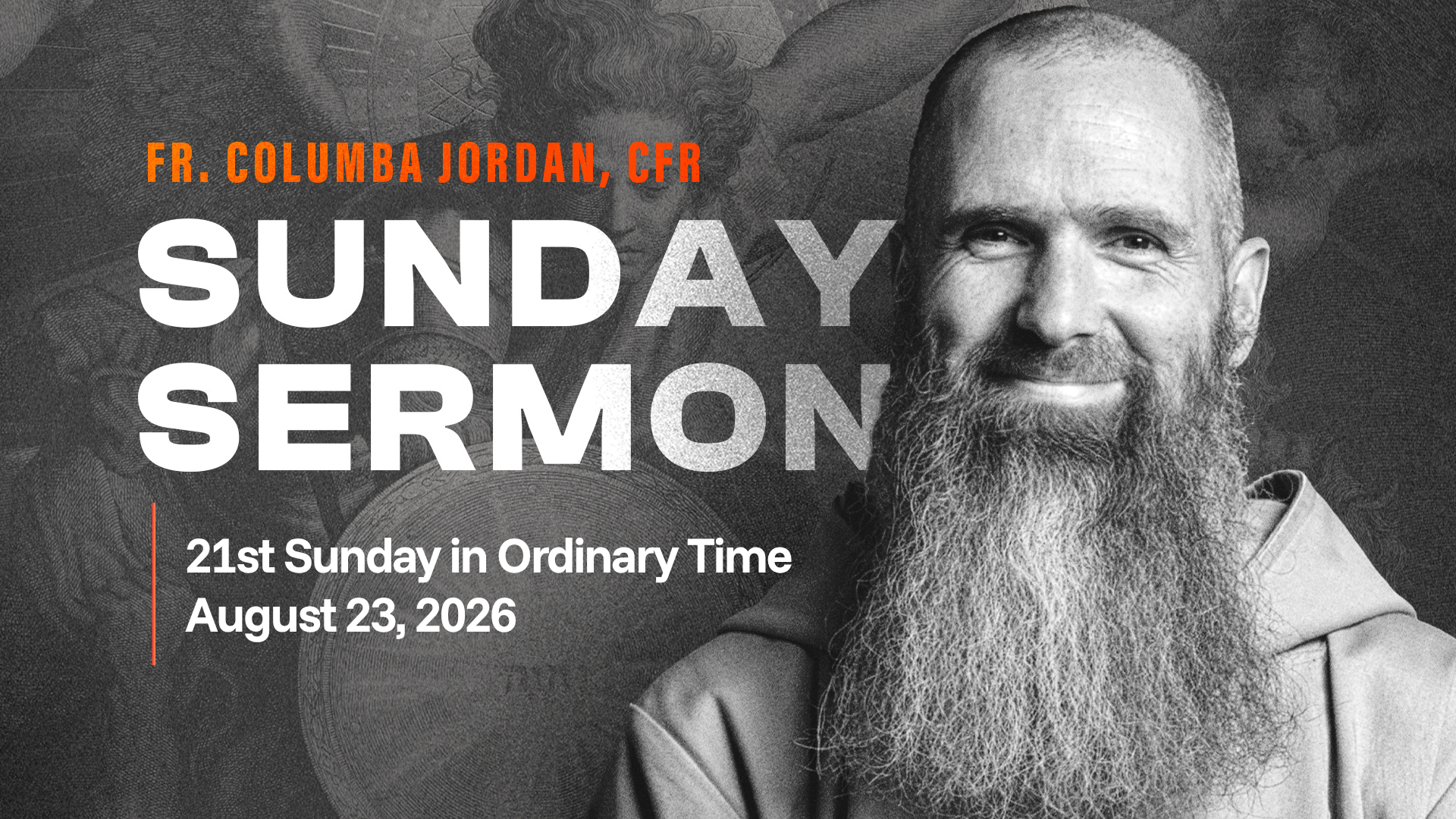
Fr. Columba’s Sunday Homily for Exodus Men
This Gospel is important for understanding why we, as Catholics, believe in the papacy, Peter’s primacy among the apostles, and the Pope’s ongoing role in the world. But there are other interesting things here. Jesus, just before he renames Simon as Peter, gives him this full title: Simon Bar-Jonah. Now, bar means “son of.” He also says this to Peter himself in John 21, but there he says, “son of John.” There are some who believe that John, Ioannes in Greek, is a kind of Greek transliteration of Jonah. But some scholars have looked into whether there’s a deeper meaning, a connection between Simon Peter and the prophet Jonah.
You may know the prophet Jonah and his story. It’s a short prophetic book told like an ancient tale. It’s very different from the style of Isaiah, Ezekiel, or any of those. The amazing thing about Jonah is that he is incredibly resistant. He is not interested at all in God’s call. He’s told to go and proclaim the message to the Ninevites, the enemies of Israel. But he runs away instead. He goes on a ship, and he’s swallowed by the whale. Eventually, he does it, though grudgingly, and he is, hands down, the most successful prophet of all time. He’s the most successful of the prophets, and he’s the most resistant. The Bible is full of different styles. There is a lot of tragedy, but I think this is more like a comedy. This is God being really humorous in the story.
The connection with Simon Peter is evident in the Acts of the Apostles. Peter, right before proclaiming the Gospel to Cornelius, the first pagan to receive the outpouring of the Holy Spirit, is in the town of Jaffa, or Joppa. This is the same town where Jonah escapes from in the Old Testament. When he comes back, it’s from this town that Jonah goes and brings the warning from God and the good news of God’s mercy to these pagans. We see a really significant connection there. Also, after today’s Gospel passage, Jesus reveals that he will be crucified and die. And Peter goes, “Absolutely not.” And Jesus calls him Satan. He rebukes him. There’s also this resistance: Peter goes back and forth like Jonah.
Is there any resistance in us that we’re aware of? We might want to be the Isaiah, Elijah, or Samuel of the prophets. But we don’t really want to be Jonah. In reality, however, we can be very resistant. Generosity is one of the most important things in the spiritual life. Can I be generous? Can I say, “It’s going to cost me, but I’ll do it anyway”? The process of sanctification has a lot to do with inner healing—how generous am I with that? Because there’s no growth without pain. We can be okay with fasting on Fridays because it grows our ego. But the real pain is the one nobody else will see or appreciate—the pain of actually growing up, of actually denying myself. I need self-denial that no one sees. For example, giving up my right to hold on to resentments. How am I with that? How am I with letting God really heal my heart, letting myself be changed—all of the pettiness I hold on to, all of the judgments, the vanity, the excessive desire for the esteem of men. “If people will just think me holy, if they’ll just think me successful,” even though my financial situation is a disaster. So we’re trapped in an ocean of lies and masks, and nobody really knows the truth. And we’re terrified. We think the only me they could ever accept is this fake version of me.
We put up this impenetrable wall to keep love from ever coming in because if someone doesn’t know me, then they can’t love the real me. And we don’t give them the chance to love the real me. And all of this is part of just one little thing called vanity. So there’s a whole load of types of resistance to his love. Oh, that we would let him know the real me—that he knows already. That we would get radically honest. That would be radically humble, radically poor, as St. Francis would have us be: “Hold back nothing of yourself for yourself, so that he who gives himself completely to you may receive you completely.”
We can be very foolish men. And yet how does the living God respond to us in our resistance, and to Peter? He trusts Peter with all of his authority. He says, “You’re like the son of Jonah. You’re flip-flopping all over the place.” And right after that: “I build my Church on you. And the gates of hell will not prevail. You will be able to conquer them. You will bind on earth, and it will be bound in heaven.” He gives him keys that reach all the way into heaven, and he says, “I will be obedient to you.” It’s exceptional. It’s amazing.
It’s like being a dad. You become a mom or a dad, and God trusts you with this child. God has embedded this trust. He communicates it to us: “I trust you.” This is how he reacts to the prodigal son, who comes back and isn’t even truly sorry; he’s just hungry. He comes back saying, “Oh, please treat me like a slave.” And how does the father react? He gives him the ring. One interpretation is that this meant giving him full access to the family money. The father trusts this completely untrustworthy person.
This is a mystery of God’s ways—that he trusts us. He trusts us with his name, his reputation. If we mess up, we know whose name gets dragged through the mud: ours, our family’s, the Catholic Church’s, Jesus’s. First and foremost, Jesus’s name is the one that’s on the line. He’s got so much skin in the game, it’s scary. And we’re sitting on the fence.
Brothers, why don’t we just ask, “How could I get off my fence a little bit more?” As they say, the fence belongs to Satan. Elijah said to the people of Israel before he defeated the prophets of Baal on Carmel, “How long will you straddle the issue?” Get off your fence. Is God God or not? Why don’t we get off the fence and be more in?
We don’t have to do this Lent perfectly. So, however it’s gone so far, let’s say, “Okay, how can I be more in?” Is there some way that I could be more in? Is there some resistance in me? Lord, whatever you want to do in me, whatever needs healing, whatever throne, whatever crown needs casting down, will you help me let go of it and let you do what you do so beautifully? Let’s surrender our resistance today.