

A Reading from the Holy Gospel According to Matthew
“What do you think? A man had two sons; and he went to the first and said, ‘Son, go and work in the vineyard today.’ And he answered, ‘I will not’; but afterward he repented and went. And he went to the second and said the same; and he answered, ‘I go, sir,’ but did not go. Which of the two did the will of his father?” They said, “The first.” Jesus said to them, “Truly, I say to you, the tax collectors and the harlots go into the kingdom of God before you. For John came to you in the way of righteousness, and you did not believe him, but the tax collectors and the harlots believed him; and even when you saw it, you did not afterward repent and believe him.
(Matthew 21:28-32)
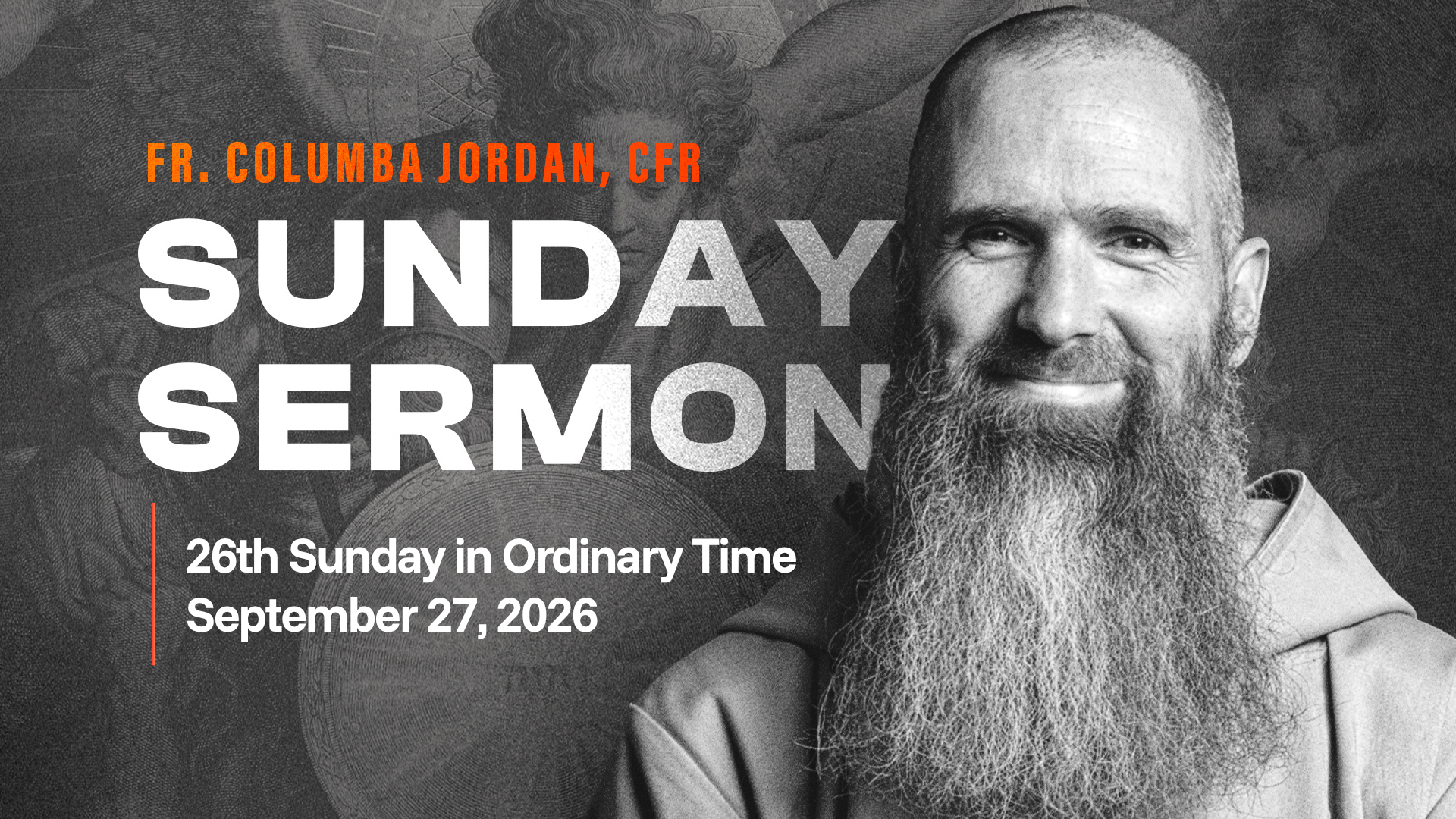
Fr. Columba’s Sunday Homily for Exodus Men
As they say, “Compare and despair.” These workers would have been fine if no one else had been hired. They would have done their work, gotten their pay, and said, “That’s great. I did an honest day’s work for an honest day’s pay. I’m really happy. I’ll go home to my wife and kids. They’re going to be delighted. I hope I get the same work tomorrow, maybe if I play my cards right.” But when other guys come in, the drama begins. They compare themselves. And Our Lord pays the last first—intentionally. Why does he do it on purpose? He wants to sift us. He wants to test us. He wants to bring out the glory, but also purify us of that not-so-glorious stuff. And out it comes.
Brothers, in the moment of pressure, we want to be like Jesus: How would Jesus react in that situation, and how do I react in that situation? It’s a great test. If I compare myself, it’s because I don’t have my eyes on gratitude. I don’t have my eyes on the Lord. I have my eyes on the man beside me, on my neighbor. And then I get locked into drama, politics, and particularly envy. At the end, the householder says, “Is your eye evil because I am good?” Envy sees the good as evil.
We’re looking at the Lord’s goodness and generosity. What would Jesus have done? He would have said, “That is incredible. This man’s willing to pay them a whole day’s wage for doing one hour. What an amazingly generous man. Can I have my denarius? Thanks very much.” The act of the householder is a revelation of his generosity at heart. It has nothing to do with people having lost anything. If Our Lord were the one witnessing it, he would definitely have rejoiced. But envy does the opposite: I see my brother receive something good, and it makes me sad. It’s like we’re trapped in thinking of scarcity, where the whole mindset is “there’s not enough.” We think there’s a limited amount of resources to go around, and if others get some, we might go hungry. Therefore, it’s dog-eat-dog.
Yet it’s fascinating that God’s inviting us into something greater. He’s inviting us to rejoice in the good, to stay free and focused. There is no limit to his goodness. There’s a limit to how much corn there is in the world. There’s a limit to how many natural resources there are. But there are some things there’s no limit to, especially with God. There is no limit to his goodness. There is no limit to his providence. So if we stay focused, we can be liberated from this thing inside us, from which so much viciousness comes. It says in Scripture that it was through the envy of the devil that sin entered the world. And it says in the Acts of the Apostles that envy was the cause for the persecution against Paul and the early Church.
This is huge, brothers: If we desire true freedom, when we start comparing, thinking we’re being stolen from—maybe it comes out as anger towards God or bitterness—let’s catch ourselves and take our eyes off the comparison and onto him. Instead, let’s say, “Okay, but what is this person doing that is good?” Let’s just stop and not get whipped up.
I have a friend who is hyper-competitive. When he had his first son, he was the proudest dad in the world, even though the kid was really young. Anytime the kid did something good, in sports or anything else, it would make him“The tax collectors and the prostitutes are going into the kingdom before you.” Imagine someone saying that to you. I would never do this if I were trying to win someone over. This is where Jesus and I just differ. It’s like going to the physical therapist. They find the place that is most uncomfortable, and they push. We’re usually tempted to do the opposite. If it hurts, we avoid it. But Jesus is not afraid of a bit of discomfort. He’s okay with us being uncomfortable. He’s not taking responsibility for our feelings, but he does take responsibility for really loving and challenging us and moving us in the right direction.
Today’s reading touches on the topic of words and actions. Ultimately, our actions are what make the man, not the talk. Talk is cheap. True—it’s still important; it’s part of the thing. Sometimes the first step we can take is to start using words in the right way. But as Fr. Benedict Groeschel, the founder of the Franciscan Friars of the Renewal, said, “When it’s all been said and done, there’s a lot more that’s been said than done.”
Actions matter. I remember hearing a talk by Jordan Peterson where he spoke about how some people say they don’t believe, but their actions say they do, while others say they believe but act as if they don’t. It’s an interesting challenge for us believers. One of the documents of Vatican II addressed this “practical atheism”: people who say they believe God exists, but their actions say the opposite. Jesus said this a lot, too, didn’t he? “Why do you say to me, ‘Lord, Lord,’ and not do what I say?”
The point is, Christianity is not a religion of an idea or theory. It’s not “the great philosophy of Christianity”. No—the Word, the theory, the idea became flesh. Jesus is one hundred percent divine and one hundred percent human. We could say that the divine is like this concept and idea, and it becomes completely united with the flesh. It starts acting in this world in a way that we can see—because we can’t see or know apart from what comes through the senses. So God enters into our flesh, into the realm of the senses. This is not a theoretical religion. It is a fact-based religion and an experienced reality.
I recently had the grace to be the chaplain for the St. Columcille Institute in Donegal, Ireland, run by Christendom College, for two weeks. And they strike a beautiful balance between teaching students and taking them on cultural trips. They were teaching them theology, history, and literature. And it was very interesting to ask the young people what they liked most about their experience. It’s amazing to go on those trips and see castles and all that, but many of them said their favorite part was the literature, which I found fascinating. You have the philosophy and the theology, but they said, “These come to life in the literature classes.”
Pope Benedict XVI said something similar about the saints, calling their lives “living theology.” It’s like understanding the Eucharist. We know what it is, but what does it truly mean? And then we see the life of a saint—what they said, how they prepared, how they were transformed by the Eucharist, what they would sacrifice to receive it—and suddenly we see its value. Literature is like this. It’s like the word becomes flesh in the writing and storytelling of these great minds and hearts, leading to a tremendous expression of thought and humanity. These kids were so engaged, and I found myself multiple times in a literature class welling up on the verge of tears at the story, but also at the truths coming to life there. It was so practical and yet also so theoretical.
Brothers, can we see something in our life that is all talk and no action, something that is all theory but with no narrative, with no story to it? Are we acting? When will we act? Are we stuck in theory?
As we end this summertime Lent, we can remain stuck in our Exodus bubble. So long as I’m with the brothers doing one of these programs, I can seem like the holiest guy in the world, but as soon as it ends, what do I look like? Has the word become flesh? This is Christianity. And St. Michael’s Lent is us trying to live out the Christian life, making it flesh, making Christ’s presence flesh in the world. Is this happening?
As we end our Lent and novena, what’s going to spark off? What’s going to change? Otherwise, the whole thing is in danger of being just talk. really proud. He would tell me, “I’ve always been so competitive, but when it comes to my son, I have this burning desire that he always be better than me. Not to push him or control him, I just want the very best from him, and I believe he’s capable of so much.” When it came to his son, all competitiveness was gone. He had no problem handing over the first place to his son. This is our Father’s heart. He wants to give you, brothers, the very kingdom. So we don’t have to worry: We are not going to get left out. Praise the Lord.